An overdue redesign three years ago might have saved the Toyota Sequoia from extinction.
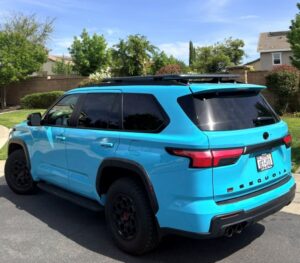
Dwindling sales hit an all-time low of 5,313 in 2022 for the full-size, truck-based SUV. The redesign came a year later and the results were significant as sales climbed to 26,186 in 2025, the most since 2008.
Despite the all-around improvements, we’re not major fans of the 2026 Toyota Sequoia. One issue is the Sequoia comes standard with a fake engine noise (Engine Sound Enhancement) that’s frankly annoying. We have no clue why the company feels this is needed
It requires a visit to a local Toyota dealer to disable the noise with a diagnostic tool, a service that’s done for free. The noise can also be stopped by using an OBD2 adapter and the Carista App.
Another major complaint with the Sequoia is the cargo area is only 11.5 cubic feet, the smallest among all large SUVs. Also, the third row doesn’t fold down completely flat because of the space needed for the hybrid battery under the floor.
Strike three against the Sequoia is how it drives. It feels bulky and there’s no sophistication in regard to handling. Frankly, this is a common trait of all large SUVs that aren’t luxury models. The Sequoia also has noticeable wind noise at higher speeds.
With the popularity of smaller SUVs in recent years, larger ones like the Sequoia have suffered. It got so bad that Toyota decided to stop production of the once popular Land Cruiser for two years (2022-23), leaving the Sequoia as the company’s lone large SUV.
The Sequoia is the longest, widest and tallest SUV in the Toyota lineup. It has three rows and can seat either seven or eight passengers, depending on the configuration (second-row captain’s chairs or bench seating). Its major rivals are the Chevrolet Tahoe, GMC Yukon, Ford Expedition, and Nissan Armada.
AT A GLANCE – 2026 TOYOTA SEQUOIA
- Performance: twin turbocharged 3.4-liter, V6 hybrid, 437 horsepower
- Mileage estimate: 19-24 mpg
- Price estimate: $65,100 to $85,500
- Warranty: 3 years/36,000 miles; drivetrain: 5 years/60,000 miles; roadside assistance: 2 years/25,000; corrosion: 5 years/unlimited; hybrid components: 8 years/100,000
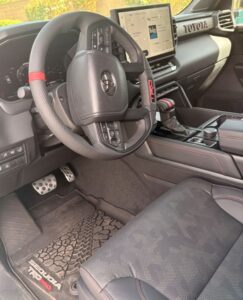
The Sequoia layout is not overly challenging to master and has
physical buttons and knobs for climate controls.
What does standout with the Sequoia is performance and fuel economy. The standard hybrid powertrain in every trim level makes the Sequoia one of the quickest and most responsive large SUVs available.
The engine is a twin turbocharged 3.4-liter, V6 hybrid that produces 437 horsepower and 538 pound-feet of torque and is paired with 10-speed automatic transmission. Depending on the trim model, the Sequoia can travel between 0-60 mph 5.5 to 6.2 seconds and gets 19-24 mpg.
The Sequoia is a major hauler as well. Towing capacity ranges between 8,980 and 9,500 pounds, which is enough to pull most midsize trailers or boats, and perhaps larger ones as well.
Although not designed for serious off-roading, the Sequoia can go there, despite its modest 8.6 inches of ground clearance. There’s an upgrade on just about every trim that offers a TRD Off-Road package that makes the Sequoia much more capable in rugged terrain.
The base model has 8-inch touchscreen, while all other trims have a 14-inch screen. A 12.3-inch digital instrument cluster comes standard across the lineup. The layout is not overly challenging to master and we like that there are physical buttons and knobs for climate controls.
There are several reasons not to value the 2026 Toyota Sequoia. Limited cargo space is one major complaint against the full-size SUV that could use some tweaking in the future.
Weidel on Wheels is featured regularly on www.tahoeskiworld.com. Auto writer Jeffrey Weidel can be reached at skiweidel@gmail.com. Follow him on Twitter at @jeffweidel.bsky.social
