Nearly nine decades ago, getting to the slopes at picturesque Sugar Bowl ski resort was quite an ordeal.
Skiers and their somewhat primitive gear were hauled into the resort on tractor-pulled or horse-drawn sleds/sleighs in the inaugural 1939 season at Sugar Bowl, then one of only three ski resorts in the undeveloped Lake Tahoe region.
At the time, there were two ways to reach Sugar Bowl – via the Transcontinental Railroad, which dropped passengers off near Donner Pass, or cautiously driving along historic Highway 40.
What about getting to Sugar Bowl on Interstate 80? That wouldn’t happen for another 25 years when the I-80 Donner Summit portion of the freeway was completed in 1964.
In the early Sugar Bowl years, there was no parking area to reach the ski resort. The only way in on the sleds took 40 minutes or more and was anything but smooth navigating across the Van Norden Meadow that led into the resort village.
Nervous passengers had to be ready for anything. Occasionally skiers would tumble off the sled and be covered in snow and have to scramble to locate their gear. It was all part of the “adventure” on the journey to the alpine village hidden beyond the meadow.
Still, the payoff was worth it. Once guests arrived at the snowbound Sugar Bowl ski lodge, the world and their own problems felt far away.
FINALLY, A GONDOLA
The rather primitive entry into Sugar Bowl lasted another 14 years before Jerome Hill, an early resort investor and major stakeholder, posed the question over lunch one day: “What if we built a gondola?” The answer was yes and that’s all Hill needed to hear.
Despite post–Korean War material shortages, Sugar Bowl made it happen. They scavenged old mining steel, recycled wire ropes, and hand-riveted the towers.
Hill personally financed and oversaw the construction of the Magic Carpet Gondola, the first of its kind on the West Coast and only the second one in North America. The gondola was the best Christmas gift the resort ever received, opening on Christmas Day in 1953 and transporting six passengers at a time on a ride that now took only seven minutes.
There were 12 aluminum cars and the new gondola could transport 280 people an hour, quite an upgrade from the sleds. The gondola was immediately embraced by all, finally providing Sugar Bowl skiers with easy access to the slopes and propelling the resort into the national spotlight.
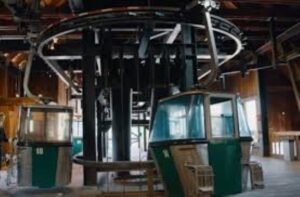
It didn’t take long for Sugar Bowl to decide to upgrade the gondola. In 1958, the resort introduced a fleet of new four-person, diamond-shaped cabins constructed with fiberglass panels over a metal framework. The gondola system was another major upgrade, capable of carrying 500 riders per hour.
It took another 25 years, but in 1983 Sugar Bowl added 50 additional cabins and modernized the terminals. It came at just the right time. Due to the resort’s increasing popularity, the updated system could transport up to 1,000 riders per hour to the Village.
JUDAH PARKING DEBUTS IN 1998
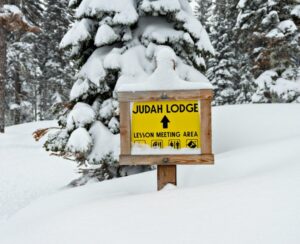
These days Mt. Judah is the preferred parking area, which was completed in 1998 by adding roughly 1,200 new parking spaces. Mt. Judah is extremely convenient, a minimal walk to the 22,000-square-foot Judah Lodge and easy access to a pair of base lifts – Mt. Judah Express and the Jerome Hill Express.
However, the gondola continued getting lots of attention, especially for skiers and riders with a sense of the resort’s history. Generations have shared the experience of being whisked across Van Norden Meadow, gliding above the treetops toward the peaks that have defined Sugar Bowl for more than seven decades.
“When people are on the gondola I think they really get a sense of the history here; it’s a definite slice of the past, a 1940-style entry into the village,” said John Monson, the former director of marketing and sales at Sugar Bowl. “Taking that gondola ride and experiencing the village literally stops people in their tracks.”
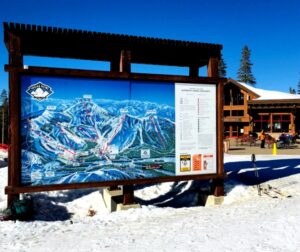
More overnight stays are possible, but where Sugar Bowl gets much of its business is still the commuter skier/rider who simply arrives for the day. The closest resort on the I-80 corridor, Sugar Bowl features 13 lifts, one gondola, 103 trails, 1,650 skiable acres, 1,500 vertical feet on a summit that rises to 8,383 feet.
And its fortunate location in the Sierra range annually gives Sugar Bowl among the highest snow totals in the Tahoe region.
“The classic charm is still here,” said former Sugar Bowl ski team foundation executive director Bill Hudson, who frequently skied Sugar Bowl in his youth. “I don’t think it’s lost that feeling. The resort has updated many things, but Sugar Bowl still has that same style people have always loved.”
UPGRADED GONDOLA DEBUTS THIS SKI SEASON
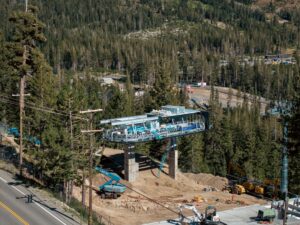
Sugar Bowl’s new 8-person Doppelmayr village gondola is scheduled to be completed and ready for the start of the 2026–27 winter ski season, with a targeted opening in November 2026.
What’s being done?
- Replacement: The new system replaces the historic 1983 Emerald Gondola.
- Timeline: Deconstruction began directly after closing day in April 2026, with heavy assembly taking place through the summer.
- Although the new gondola will follow the same familiar route over the train tracks, each of the seven towers are being replaced.
- Capacity: Upgraded to a modern 8-passenger Doppelmayr D-Line system for improved reliability and capacity.
