In late October, there was an unusual looking vessel traveling rapidly up and down the gorgeous blue, turquoise waters of Lake Tahoe. For many observers, the question was probably – what’s that?
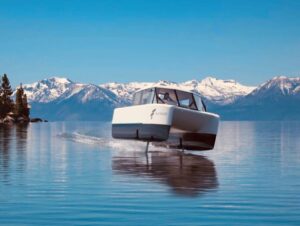
The all-electric hydrofoil passenger VS-9 arrived in the U.S. in October and was involved in on-water demonstrations in Lake Tahoe for several days. The VS-9 is a 29-foot vessel developed by marine technology company – Vessev.
The transit startup FlyTahoe has partnered with Vessev to eventually employ a fleet of these high-tech, zero-emission “flying” boats on Lake Tahoe to serve as an eco-friendly ferry network that will play a role in reducing the year-round traffic congestion in the Tahoe region. The projected target date is early 2028.
“We’re proud to be Vessev’s first U.S. customer and to add the VS–9 to our growing fleet of electric hydrofoiling vessels,” said Ryan Meinzer, Founder and CEO of FlyTahoe. “We selected the VS–9 for its purpose-built commercial design and premium passenger experience, with panoramic glass windows, connecting passengers to Lake Tahoe’s scenery.”
Why was this a notable sight to see the VS-9 in the Tahoe waters? Because the vessel had previously been discussed locally, but instead of mere pictures and videos, this time FlyTahoe provided an actual demonstration of the VS-9 traveling along the lake as a preview of America’s first electric flying ferry.
“FlyTahoe is developing a sustainable water transit network on Lake Tahoe. Our vision is to cut travel time in half for the 20,000 daily drivers traveling between North and South Tahoe, while preserving the lake’s clarity by eliminating road sediment and emissions,” Meinzer said.
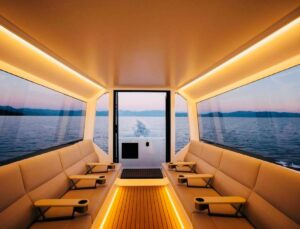
By delivering 10 times the operational efficiency gains through electric hydrofoil technology, FlyTahoe says traveling across Lake Tahoe will be cheaper than driving around it. The VS-9 has a range of 50 nautical miles and a cruising speed of roughly 28 mph.
The 105-kWh battery can be fully recharged in approximately one hour on DC Fast Charging or five hours on AC power. Much like an electric vehicle, the VS-9 travels quietly. FlyTahoe will deploy multiple vessels on the lake at one time. Each VS-9 is designed to transport 10 passengers.
FlyTahoe is building the operating system for sustainable water transit networks, beginning in Lake Tahoe. FlyTahoe’s planned electric flying ferry is highlighted in the Lake Tahoe Regional Transportation Plan.
Charging Station at Tahoe Keys Marina: FlyTahoe recently announced the installation of a new marine power pedestal at Tahoe Keys Marina, designed to support the first direct-current fast-charging (DCFC) capability at a South Lake Tahoe marina for electric vessels.
Installed at the marina’s premier private slip to support FlyTahoe’s planned electric vessel operations, including the use of the VS–9, the pedestal sits immediately adjacent to the gangway and the site of the Tahoe Keys Marina Redevelopment Project.
Its 100-amp, 480-volt, three-phase supply was specifically designed to power a compatible movable DC fast charger for FlyTahoe’s electric flying ferry fleet, establishing the electrical foundation for a critical South Shore charging location.
The installation lays the groundwork for FlyTahoe’s faster vessel turnaround and future connections between shoreline communities and other destinations, subject to regulatory approval.
“Reliable dockside fast-charging power can expand opportunities for both commercial and recreational electric boating,” Meinzer said. “This installation is a major unlock for our sustainable water transit network. We’re building the critical infrastructure necessary to connect Lake Tahoe’s shoreline communities, while protecting the lake that unites us, and working to expand charging infrastructure throughout the basin.”
The installation adds a South Shore location with infrastructure designed to support DC fast charging, complementing existing DC fast chargers at Tahoe City Marina and Homewood High & Dry Marina.
Awaiting Regulatory Approval: Timing for commercial service remains subject to regulatory approval. FlyTahoe is actively working through the required federal, state and local processes with the goal of bringing service to Lake Tahoe as quickly as possible.
This latest release regarding DCFC is a significant milestone for developing a sustainable water transit network.
“As you can imagine, there are many moving parts to make this a reality,” Meinzer said. “Regulatory approvals are one facet, electric charging infrastructure is another, and the vessel itself is yet another.”
